


If you’re tired of glasses and contacts, you’ve probably heard of LASIK. But LASIK is just one of several ways to see clearly, and the best choice depends on your eyes, your age and the way you live.
PRK, ReLEx SMILE, EVO ICL, refractive lens exchange and cataract surgery each suit different people. With that many options, it’s easy to feel stuck before you even start.
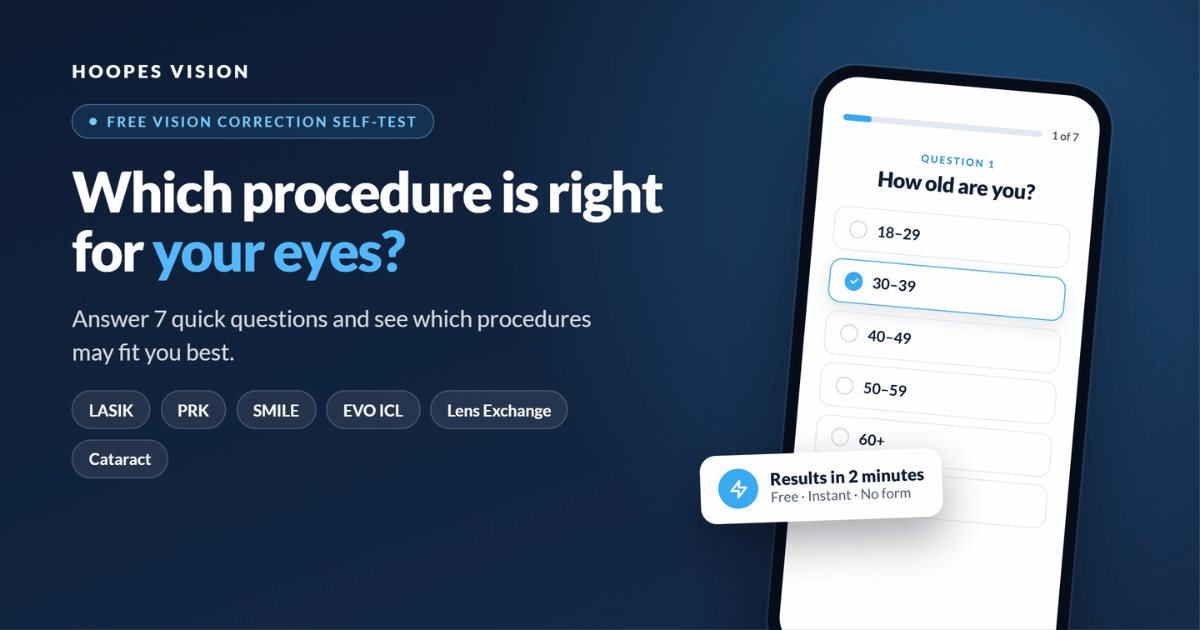
That’s why we created the new Hoopes Vision Vision Correction Self-Test. It’s a free, two-minute quiz that shows which procedures you may be a candidate for, right away.
How the vision correction self-test works
The self-test asks 7 quick questions about the things that matter most when choosing a procedure:
- Your age
- What you wear now: glasses, contacts, both or readers
- What’s hard to see without them: far away, up close or at night
- What an eye doctor has told you, such as nearsightedness, farsightedness or astigmatism
- Eye conditions like dry eye, thin corneas, cataracts or keratoconus
- What matters most to you, from a fast recovery to an active lifestyle
- When you’d like to see clearly
Most people finish in about two minutes. There’s no form to fill out and no email required. Your results appear on the screen as soon as you answer the last question.
The 6 procedures the self-test compares
There’s no single best procedure. Here’s a quick look at who each one often suits.
- WaveLight Plus LASIK: Often a great fit for adults from 18 to their mid-40s with a stable prescription. LASIK corrects nearsightedness, farsightedness and astigmatism, and most people notice clearer vision within a day. In Utah, WaveLight Plus LASIK is offered only at Hoopes Vision.
- PRK: Corrects the same prescriptions as LASIK without a corneal flap. It’s often chosen by people with thinner corneas and by those in contact sports, the military or law enforcement.
- ReLEx SMILE: A flapless laser procedure for nearsightedness and astigmatism, done through a tiny keyhole opening. It’s a strong option for active people and those concerned about dry eye.
- EVO ICL: An implantable lens for higher prescriptions, thin corneas or dry eye. No corneal tissue is removed, and the lens can be removed if needed.
- Refractive lens exchange: Often the best fit after your mid-40s, when reading glasses become part of life. A lens implant can correct both distance and near vision.
- Cataract surgery: For cloudy vision, glare or halos caused by cataracts. Premium lens options can also correct astigmatism and reduce your need for glasses.
What your results mean
Your results show your best potential match first, followed by other procedures worth exploring. Each result explains why it may fit you, based on your answers. If you mention something like keratoconus, cataracts or a prescription that changed recently, the self-test points that out too.
The self-test is a starting point, not a diagnosis. It can’t measure your eyes. Only a comprehensive eye exam can check the thickness and shape of your corneas, confirm your prescription and determine which option, if any, is right for you.
Think of it as a way to walk into your consultation already knowing which questions to ask.
Take the first step
Ready to see what’s possible? Take the free Vision Correction Self-Test and get your results in about two minutes.
When you’re ready to know for sure, book a consultation online or call 801-568-0200. Consultations for LASIK, PRK, SMILE and EVO ICL are free, with no obligation.