

Presbyopia
If reading glasses have become a constant companion, certain IOL designs may reduce the need for glasses at multiple distances.
HOOPES VISION | DRAPER, UTAH
What if the next step in vision correction was not reshaping your eye, but replacing the lens inside it?
Refractive Lens Exchange (RLE) is an advanced vision correction procedure that replaces your natural lens with an artificial lens selected for your eyes and visual goals.
For appropriately selected patients, RLE may reduce dependence on glasses or contacts and address age-related changes in near vision.
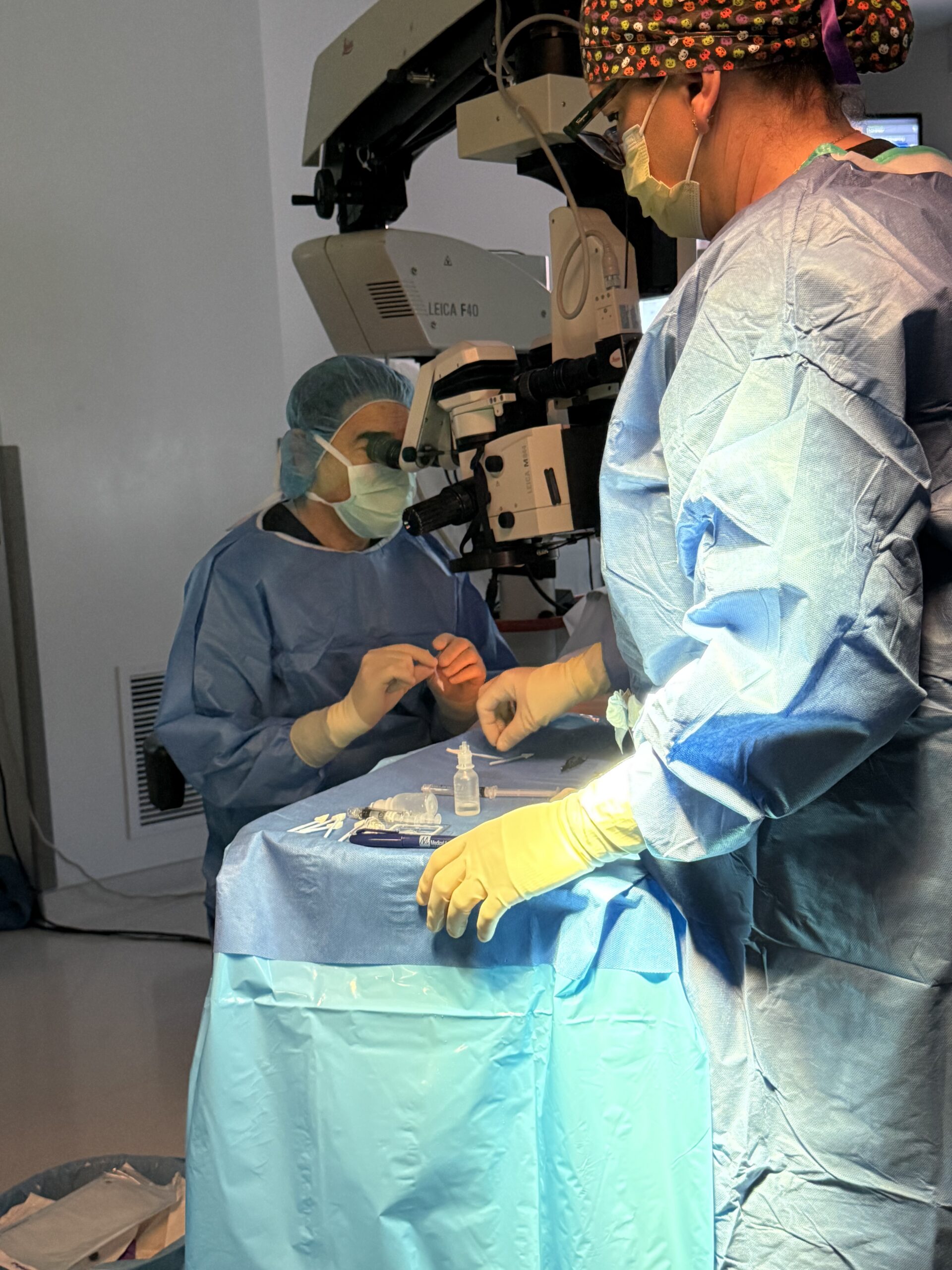
Understanding RLE
Inside every eye is a natural crystalline lens that helps focus light onto the retina. When we're younger, that lens is flexible and changes shape to help us see at different distances.
As we age, the natural lens gradually loses flexibility. This condition, known as presbyopia, makes it increasingly difficult to focus on nearby objects, even when distance vision remains clear.
Refractive Lens Exchange addresses vision correction at the lens itself. During the procedure, the surgeon removes the natural lens and replaces it with an artificial intraocular lens, or IOL.
Depending on the lens selected, RLE can correct nearsightedness, farsightedness, astigmatism, and some of the focusing challenges associated with presbyopia.
Because the natural lens has been removed, that eye will not later develop a cataract in the original natural lens. However, other vision changes and eye conditions can still occur.
THE DIFFERENCE
CANDIDACY
RLE may be worth exploring when age-related focusing changes, your prescription, or your vision goals make lens-based correction more appropriate than corneal laser surgery.
If reading glasses have become a constant companion, certain IOL designs may reduce the need for glasses at multiple distances.
Patients with farsightedness and age-related loss of near focusing ability may benefit from consideration of RLE.
Some prescriptions may be better addressed with lens surgery than LASIK or PRK, depending on the eyes and individual risks.
A toric intraocular lens can be considered when astigmatism correction is part of a personalized lens exchange plan.
Patients interested in reducing reliance on multiple pairs of glasses may wish to discuss lens designs offering more than one range of focus.
A detailed evaluation helps determine whether RLE is appropriate or whether LASIK, PRK, ICL, or another treatment offers a better balance of benefits and risks.
INTRAOCULAR LENS TECHNOLOGY
Selecting an intraocular lens is one of the most important decisions in refractive lens exchange. The right choice depends on your eyes, visual priorities, and preferences.
Designed primarily to focus at one distance, commonly far away. Glasses may still be needed for near tasks or other distances.
Specifically designed to address corneal astigmatism. Toric correction can be incorporated into certain monofocal and advanced lens designs.
Designed to provide focus at multiple distances, potentially reducing dependence on reading glasses. Some patients experience halos or glare.
EDOF lenses are designed to provide an extended range of focus, often particularly useful for distance and intermediate activities. Reading glasses may still be needed.
In selected patients, one eye may be targeted for distance and the other for near or intermediate vision. This approach requires careful discussion.
Computer use, night driving, reading, outdoor activities, and eye health all matter when selecting an intraocular lens.
Lens models and availability vary. Your surgeon will explain which options are appropriate for your eyes.
THE PATIENT JOURNEY
RLE uses surgical techniques similar to modern cataract surgery. The process begins with a thorough evaluation and a customized lens plan.
Your surgeon evaluates your vision, overall eye health, and visual goals to determine whether surgery is appropriate.
Detailed measurements help calculate the appropriate lens power and determine which IOL design may fit your needs.
Through a small incision, the natural lens is removed and the selected artificial lens is implanted.
Your care team monitors healing, vision, and the lens position. Recovery and visual adjustment vary by patient.
UNDERSTANDING YOUR OPTIONS
Different vision correction procedures work on different parts of the eye. Understanding the distinction can help you ask the right questions during your consultation.
| Procedure | What It Does | Natural Lens |
|---|---|---|
| Refractive Lens Exchange | Replaces the natural lens primarily to correct vision before significant cataract formation. | Removed and replaced with an IOL |
| Cataract Surgery | Removes a cloudy lens and replaces it with an artificial lens. | Removed and replaced with an IOL |
| Laser-Assisted Lens Surgery | A laser may assist with selected steps of RLE or cataract surgery. | Replaced during the lens procedure |
| EVO ICL | Places an implantable lens inside the eye without removing the natural lens. | Preserved |
| LASIK / PRK / SMILE | Changes the corneal shape to correct refractive error. | Preserved |
WHY HOOPES VISION
At Hoopes Vision, technology is only part of the story. Our approach begins with understanding your eyes, your lifestyle, and the quality of vision you hope to achieve.
Hoopes Vision has a long history of innovation in refractive surgery and lens-based procedures.
Our Draper facility includes EyeSurg of Utah, an on-site ambulatory surgery center designed for specialized ophthalmic surgical care.
From comprehensive evaluation and diagnostic measurements to lens selection and postoperative care, every treatment recommendation is based on your individual needs.
OUR APPROACH
MAKING AN INFORMED DECISION
RLE is elective intraocular surgery. Like all eye surgeries, it carries risks and is not appropriate for everyone.
Potential complications include infection, inflammation, swelling, retinal detachment, lens positioning problems, and vision changes. In rare cases, complications may cause permanent vision loss.
Some lens designs may cause glare, halos, or reduced visual quality in certain lighting conditions. Some patients continue to need glasses.
Patients with significant nearsightedness, certain retinal conditions, or other eye diseases may require additional evaluation or may be better suited to another approach.
Your surgeon will discuss your individual risks, expected outcomes, and alternatives before you decide whether to proceed.
IMPORTANT TO KNOW
Refractive lens exchange permanently removes the natural lens, including its remaining ability to accommodate.
For younger patients whose natural lenses still focus effectively, preserving that function may be an important reason to explore alternatives.
The goal is not simply to choose the newest procedure, but to choose the procedure best suited to your eyes.
FREQUENTLY ASKED QUESTIONS
The surgical techniques are very similar. Cataract surgery removes a cloudy natural lens, while RLE is generally performed before the natural lens has developed a visually significant cataract.
Some lens implants can reduce dependence on reading glasses by providing more than one range of focus. Results vary according to the lens design and the health of your eyes.
Possibly. Many patients experience less dependence on glasses, but no lens implant can guarantee complete glasses independence. Some activities may still require correction.
The replacement lens cannot develop a natural cataract. However, the remaining lens capsule may become cloudy over time, a condition known as posterior capsule opacification. This can often be treated with a laser procedure.
Neither procedure is universally better. LASIK corrects vision by reshaping the cornea, while RLE replaces the natural lens. Your age, prescription, eye health, and visual needs determine which options are appropriate.
EVO ICL is an implantable lens placed inside the eye while the natural lens stays in place. RLE removes the natural lens and replaces it with an artificial lens.
Many patients notice visual improvement relatively soon, but healing and stabilization take longer. Recovery varies, and some advanced lens designs require additional time for visual adaptation. Your surgeon will provide specific instructions.
RLE performed primarily for refractive vision correction is generally considered elective and is not typically covered by medical insurance. Cataract surgery has different coverage criteria. Our team can help explain your individual situation.
YOUR VISION STARTS HERE
Wondering whether Refractive Lens Exchange, LASIK, EVO ICL, or cataract surgery is right for you?
Our team will help you understand your options and identify the next steps toward a personalized vision correction plan.